 Press
Social Media
Press
Social Media
Love and Hate – My Journey with Vieuxtemps’s Capriccio for Solo Viola, Op. 55
By Pinar Özoral, summer 25
I want to tell you a personal story about Henri Vieuxtemps’s Capriccio for Solo Viola. This is a piece I used to hate—and now deeply love. Its name, Capriccio, suggests sudden changes of mood, and maybe I should have guessed that my feelings toward it would constantly shift too.
The first time I played and recorded it, I felt completely lost. I had avoided this piece for a long time. It was technically demanding, emotionally intense, and somehow uncomfortable for me. I didn’t feel ready for it.
There were a few reasons for that feeling:
- Extreme technical demands: Vieuxtemps dedicated this piece to Paganini, the legendary violinist known for his dazzling virtuosity. Vieuxtemps had met Paganini as a child prodigy, and this encounter opened a whole new world of instrumental possibilities. Surprisingly, this capriccio is not very fast and doesn’t sound very virtuosic, but it has incredible technical challenges—like wide shifts across the fingerboard, a constant movement between registers that makes it very difficult to control the intonation.
- No support: This piece is for solo viola. No piano, no orchestra. Nothing to “hide behind”—I’m completely exposed.
- Balancing Control and freedom: The music has a spontaneity; it has to feel free, almost improvised. But, on the other hand, it requires incredible precision for a good execution. This taught me something important about performance (and even about life): freedom and control can, and should, exist in balance.
I felt like I was being dropped into an emotional landscape with no map.
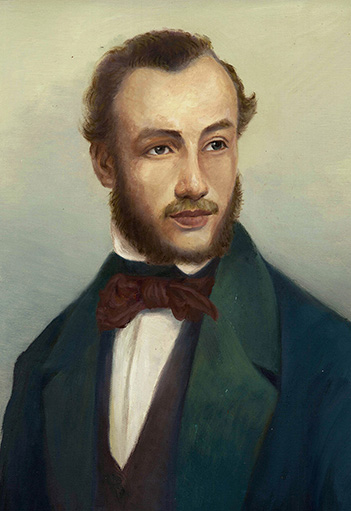
Henri Vieuxtemps (1820-1881)
But slowly, while working on the piece, something changed. As I spent more hours with it, I began to understand the emotional depth behind the notes, which are written in a melancholic C minor key. I realized it wasn’t about playing everything perfectly. It was about honesty. I started to enjoy the silence in the music—the pauses that gave me, and the music, space to breathe.
I stopped trying to impress and started trying to communicate.
This piece showed me something important: emotional power doesn’t have to come from big gestures or drama. It can be quiet, internal—almost like someone speaking softly to themselves. And maybe that’s why I connect with it so deeply now. I’m Turkish, and I feel that my culture tends to lean into larger-than-life, somewhat dramatic emotional expressions. I also like and appreciate this—we are not shy people, and we often show our feelings in a strong and open way. But this piece taught me the beauty of restraint. It was asking me for something different. It wanted me to be quiet instead of loud. To stay calm instead of letting everything out.
At first, it was hard. I felt like I wasn’t saying enough. But later, I realized that even a simple, honest note can touch people more than fast, difficult music.
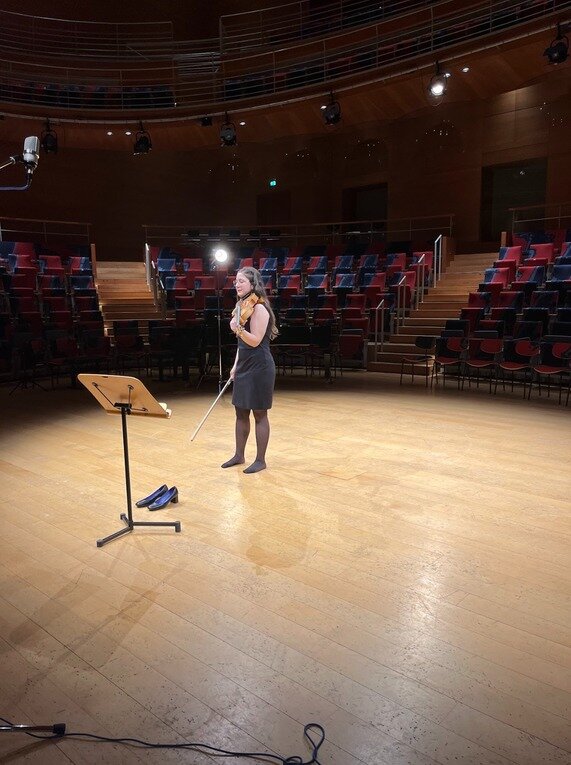
Recording at the Pierre Boulez Saal, 2025
It’s just me and my viola. No accompaniment. No orchestra. No piano. Just a solo voice, and the courage to be vulnerable. The more I think about it, the more I see that this journey with the Capriccio mirrors my journey with music itself. There are hard days and moments of doubt. But every time I play it, I feel like I’m speaking directly to myself. And I’ve discovered something new about who I am—both as a musician and a person.