 Press
Social Media
Press
Social Media
Where the light wins - meditations on the dualism of the art of performing
By Idil Bursa, summer 25
Why is it so different to play in the practice room and on stage? I know I’m not the only one who always feels like I’m in two completely different spaces — physically and mentally. It’s clear that playing for a big audience, in a formal concert setting, has its effect on us, pushing every possible button in our nervous system and psychological mechanism, and perhaps even changing our perception of reality. I personally have heard from musicians who have been performing for over 20 years that they are still nervous when they walk on stage, sometimes to the extent of actual stage fright. Why is this the case? Why don’t we get used to the feeling of a concert and the effects of adrenaline and excitement? Why do our mind and body keep reacting to it as if it were a new thing?
I’ve thought about this topic a lot in my life. I’ve had my share of ups and downs when it comes to my relationship with the stage (and I still do…). When I was a kid, a performance was merely another thing I had to do, not too serious, not too much of a big deal. Back then I wasn’t aware of the so-called ‘rules,’ ‘traditions,’ and ‘norms’ of the classical music world. During my teenage years, I was feeling rather insecure and spiritually lost, as I imagine many other teenagers do. It was difficult to express myself musically in front of other people when I could hardly even express myself to myself. There were endless emotions, ideas, inspirations, but it was all like a soup — difficult to define, separate, and structure.
Going into my twenties, the inspiration and ideas I had bottled up during my teenage years met with a more mature and developed rationale. I’m currently on the way to finding the balance between playing my soul out to the audience and still maintaining a certain ‘respectable’ artistic persona, one that is capable of precise and knowledgeable musical decisions. And I have the feeling that this search will keep on going forever, which is both scary and encouraging at the same time.
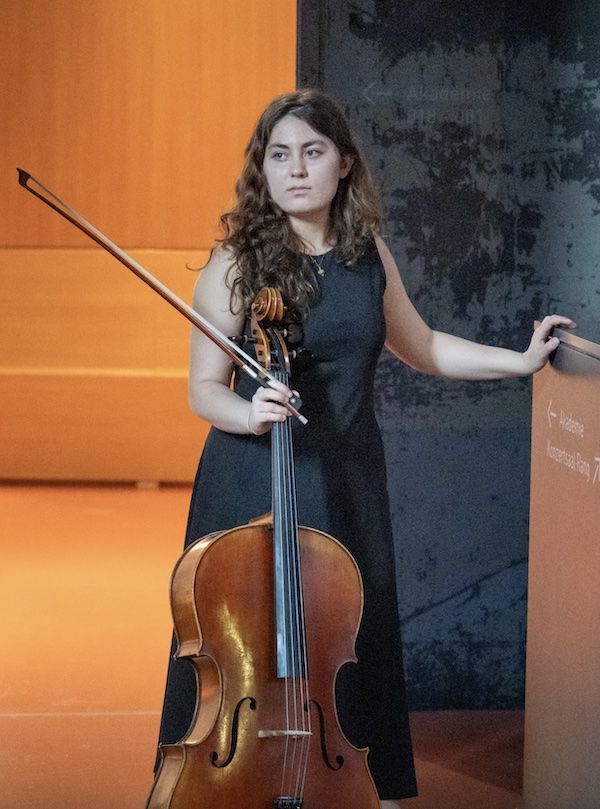
In a way, I feel like every time I go on stage, I am reborn — reborn into a new life, bound to discover and perceive everything for the first time. And this rebirth can be a little bit of a Russian roulette. What feeling I will have on stage in a given moment — surely depends mostly on me; how prepared I am, how enthusiastic or energetic I feel, but not only. It also depends on who is listening to me, what’s the purpose of the concert, who I’m playing with, what’s my connection to the piece, whether I’ve played it before or if it is completely fresh…
So one question in my mind emerges: How can I make each time perfect (or as close as possible to my idea of perfect)? In my eagerness to achieve perfection, I often encounter a deep struggle, surprisingly mostly connected to the experiences I’ve had in the past. If I had played a piece some years ago, and a performance of it didn’t go as well as I wanted, or I made an unfortunate mistake, this experience could haunt me for a long time. My mind becomes hesitant, which in the end could potentially make me repeat the mistake, or just be unfocused and uninspired.
Is it really all in our heads? Logically, I know that I’m at a much more advanced point in my development than a few years ago. My technique evolved, I’m more stable, I know what to look for musically, and I have a clearer path to achieve my artistic goals. But these past ‘traumas’ are like my ghosts, and I feel that I need to battle them with the light of the music-loving soul that is within me.
Luckily, most of the time the light wins. Because, as cheesy as it may sound, love will win against anything — as long as we put our guard down and let it penetrate our soul and mind. We need to get rid of our ego and self-loving selfishness and understand that the music we play serves the universe itself and speaks the universal language, far from the concept of ‘me, my, mine, ours.’
In this video, I talked about Dvořák’s Waldesruhe and the great significance this piece had for me in terms of stage fright. This mirrors the opposite of my traumatic past experiences; here I had a pure, beautiful musical experience that left me with a deep understanding of what a positive experience on stage should and could feel like.
Here I felt like I, Idil, am simply a messenger of this magical spell which is the music. This surely takes the burden off my shoulders — but is it realistic, or authentic, to take myself completely out of the equation? How am I supposed to get inspired or tell any story of my own as an interpreter? If I’m nothing but a ‘messenger’ — how can I be a significant part of the story, and why should people listen to me? The answer to this question will perhaps never be complete, but what I can say is that balance might be the key. Balance between the composer’s wishes and the interpreter’s personality; between the experiences of the past and the novelties of the present; between insisting on professionalism and precision, and allowing oneself to let go. Once such a balance is achieved, an artist can blossom and show themselves to the world through music.
Maybe when I can achieve this balance, I will come closer to being a ‘true’ artist, or the ultimate form of myself. Maybe I shouldn’t even think about all this, and just ‘be,’ which might actually be the best option (although easier said than done…). And perhaps I should embrace the exhilaration I feel from the unknowingness of it all, which in the end makes me feel more alive.